Pearson Edexcel · GCSE · Mathematics
Course version: 1MA1 · Version from Mar 2026
Geometry and measures - Mensuration and calculation: calculate arc lengths, angles and areas of sectors of circles
One fraction unlocks the curved edge, shaded area and missing angle of any circle sector. Learn how to turn θ/360 into reliable Edexcel GCSE marks, avoid the perimeter trap and test your recall with worked questions, diagrams and a ten-minute tutor podcast.
- 13 min read
- 4 worked examples
- 6 practice questions
- 11 key terms
Try the lesson
The start of the Geometry and measures - Mensuration and calculation: calculate arc lengths, angles and areas of sectors of circles lesson, made from checked teaching notes for this specification point.
Have a go first
A sector of a circle has a radius of 9 cm and an angle of 40° at the centre. Work out the area of the sector. Give your answer in cm², correct to 1 decimal place.
There is more to this lesson
The full lesson goes on to check your understanding and help you earn the marks. Create a free account to carry on, with your progress saved.
7 days Premium · Then the free plan continues · No card, no charge
Check what you remember
Read the wording for your board, then hide it and explain Sector in your own words. Rough notes are fine. This is a self-check, with no mark or grade.
Reference: Pearson Edexcel
A region of a circle bounded by two radii and the arc joining their endpoints.
Study Notes
Overview
A sector is a slice of a circle, bounded by two radii and an arc. The central angle tells you what fraction of the whole circle the slice occupies. Once you recognise that fraction, arc length and sector area become familiar circle calculations rather than unrelated formulas. Perimeter adds one further decision: which edges belong to the complete boundary?
Pearson Edexcel GCSE Mathematics assesses this under 1MA1, G18: calculate arc lengths, angles and areas of sectors of circles. The core content is on both Foundation and Higher tiers, not Higher-only. Pearson's content guidance gives past-paper examples for each tier. 1 2
Candidates may be asked to calculate a curved length, find a shaded area, recover a missing central angle, or combine sectors with other shapes. These questions connect fractions and proportion with algebra, angle facts, units and exact answers involving π. The most reliable approach is to identify the required quantity before substituting numbers. Work through the examples, then cover the solutions and reproduce the reasoning. In this guide, original Edexcel-style questions have precise but indicative teaching mark allocations; they are not official Pearson mark schemes.
Key Concepts
1. Identify the sector, arc and central angle
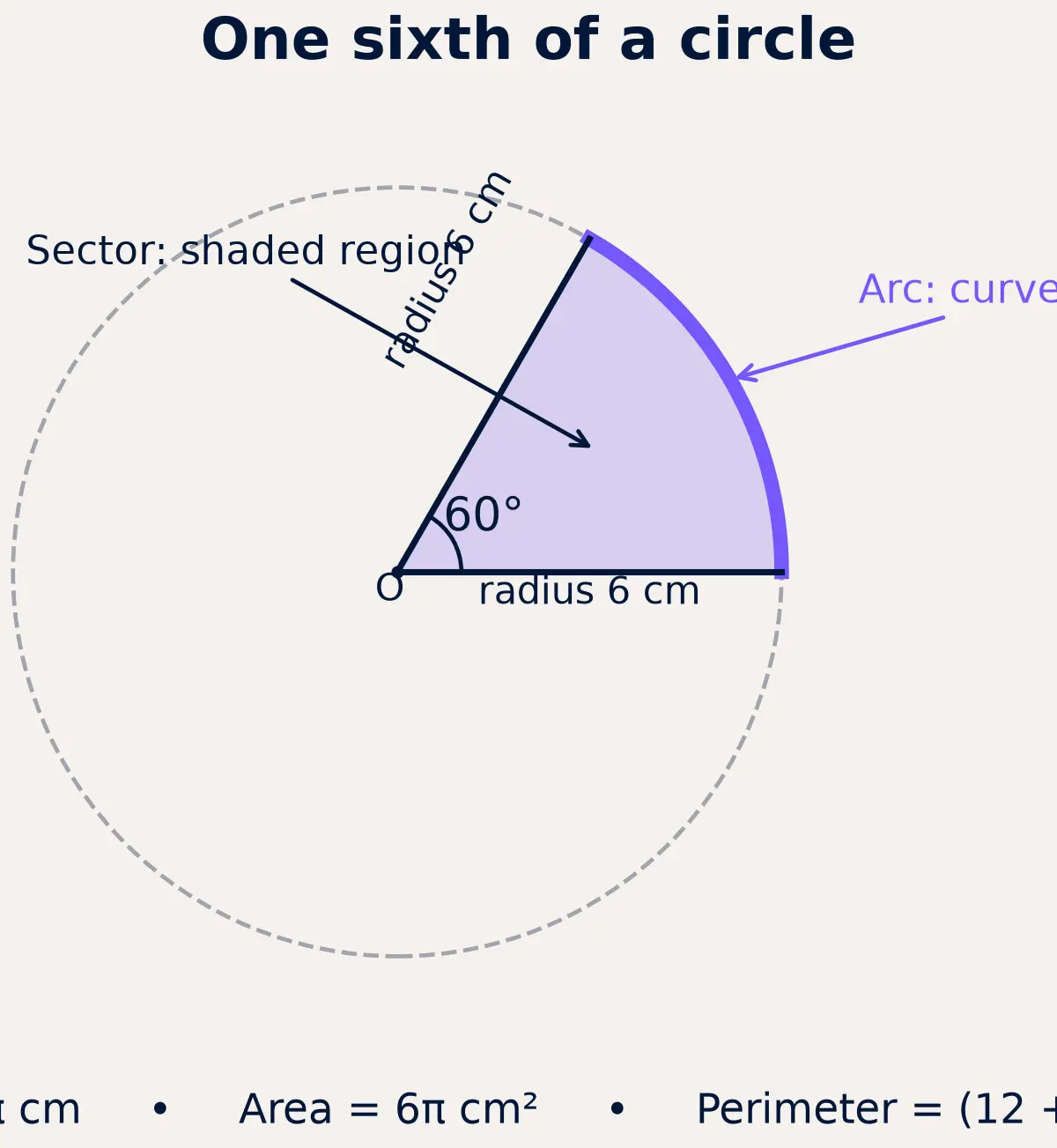
The radius, r, runs from the centre to the circumference. The diameter, d, passes through the centre and equals 2r. The arc is the curved part of the circumference. The sector is the enclosed region between two radii and that arc. A chord is a straight line joining two points on the circumference: it is not an arc.
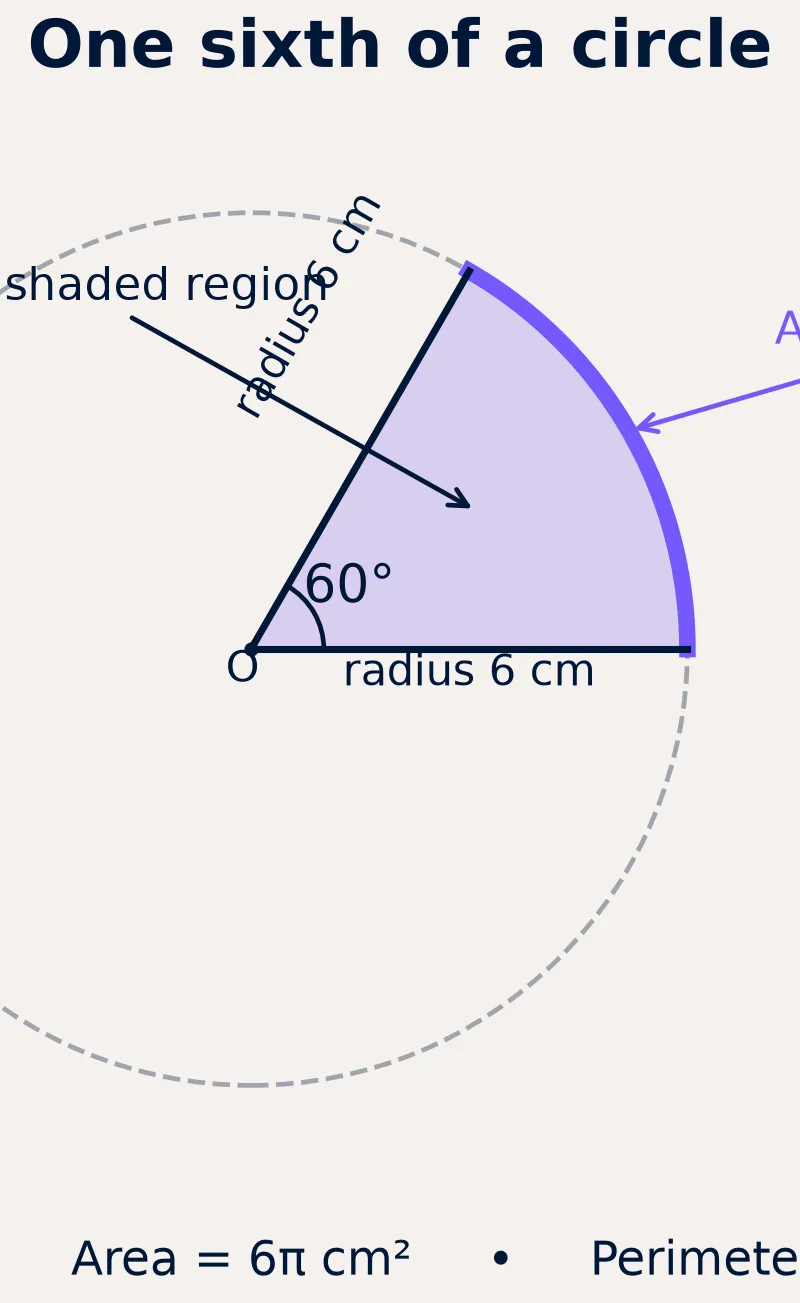
In the illustration, the angle at O is 60°. Six equal 60° sectors fill the circle, because 6 × 60° = 360°. Each therefore has one sixth of the circumference and one sixth of the area. This is why the same fraction works for both calculations, even though their whole-circle formulas differ.
Do not measure a diagram unless instructed. Mathematical diagrams need not be drawn to scale. Read the stated lengths and angles instead. Cover and recall: identify the centre, both radii, the arc and the region without looking at the labels.
2. Fraction first: θ/360
Write f = θ/360, where θ is the central angle in degrees. A 90° sector is 90/360 = 1/4; a 120° sector is 1/3; a 72° sector is 1/5. These fractions describe the selected portion of one complete turn.
Dividing by 180 is incorrect because 180° represents only half a circle. For a 60° sector, 60/180 = 1/3 wrongly doubles the required fraction. A useful check is that an angle smaller than 180° produces a fraction smaller than one half.
If the angle is not supplied directly, use angle facts first. Angles around a point total 360° and angles in a triangle total 180°. If a triangle contains two radii, it is isosceles, so its base angles are equal. Identify the central angle before selecting the fraction.
3. Arc length: a fraction of the circumference
The whole circumference is C = 2πr = πd. Hence L = (θ/360) × 2πr. L is a length, so its unit is cm, mm or m, not a squared unit.
For radius 6 cm and angle 60°, f = 1/6. The whole circumference is 12π cm, giving L = (1/6) × 12π = 2π cm. On a calculator, this is approximately 6.28 cm to two decimal places. Keep 2π if the question requests an exact answer in terms of π.
A valid substitution shows the intended method even if subsequent arithmetic slips. Credit given for that working depends on the individual mark scheme. Do not assume a bare fraction earns a separate mark in every question. Why does this work? Explain why using πr² would measure the wrong kind of quantity.
4. Sector area: a fraction of the circle area
The whole area is πr², so A = (θ/360) × πr². Square the radius, not the diameter and not the whole fraction. For the same 6 cm, 60° sector, A = (1/6) × π × 6² = 6π cm², approximately 18.85 cm².
If a diameter of 12 cm is supplied, first write r = 12/2 = 6 cm. Using 12 as the radius makes the area four times too large. This is a common error because the dimension printed across a whole circle looks easy to substitute directly.
For fixed radius, area is proportional to angle. For fixed angle, area is proportional to r². Doubling the radius doubles the arc but quadruples the area. This distinction links sector calculations to similarity and helps candidates judge whether a numerical answer is plausible.
5. Perimeter: trace every boundary piece
The perimeter of an ordinary sector is P = L + 2r. Starting at the centre, trace one radius, the arc and the other radius. The curved edge alone is not the complete boundary.
For the example above, P = 2π + 6 + 6 = (12 + 2π) cm, approximately 18.28 cm. Notice that sector area and perimeter happen to have similar decimal values here; they are still different measurements with different units.
In a composite shape, count only the outside boundary. A radius drawn inside a shape may be a construction line rather than an exposed edge. Do not automatically add 2r to every curved-shape problem. Draw a fingertip route around the actual perimeter and list its component lengths before calculating.
6. Missing central angles: part divided by whole
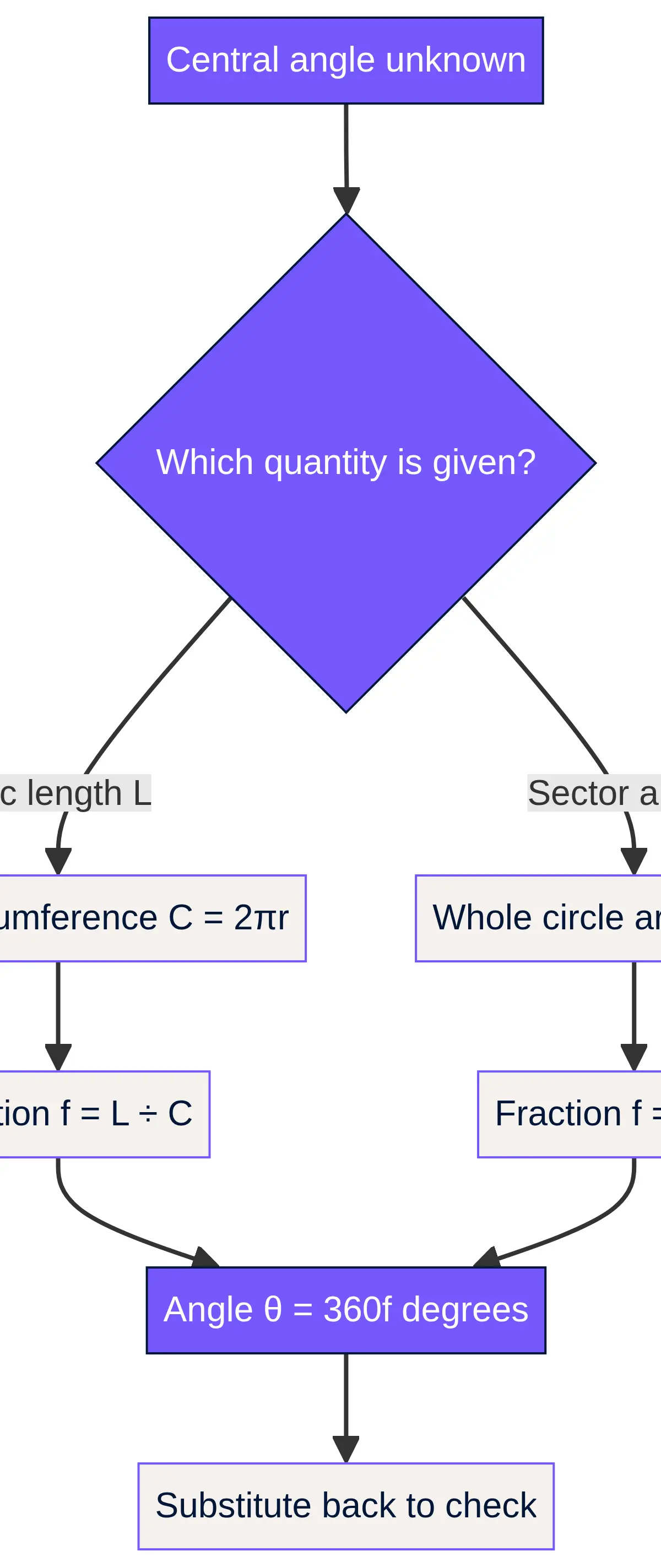
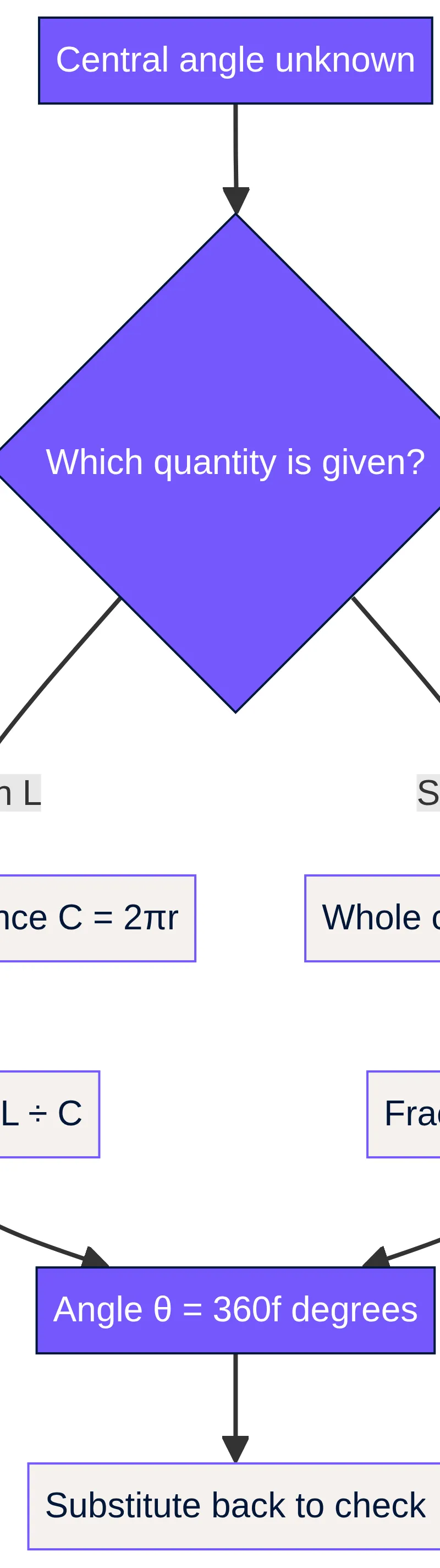
Reverse questions use the same fraction. Given arc length L and radius r, calculate f = L/(2πr), then θ = 360f. Given sector area A, calculate f = A/(πr²), then θ = 360f.
Example from an arc: r = 9 cm and L = 6π cm. The fraction is 6π/(18π) = 1/3, so θ = 120°. Example from an area: r = 8 cm and A = 16π cm². The fraction is 16π/(64π) = 1/4, so θ = 90°.
The numerator and denominator must describe matching quantities. Dividing an area by a circumference cannot produce the dimensionless fraction required. Substitute the recovered angle back into the original formula: it should reproduce the given measurement. If the problem gives perimeter rather than arc length, first subtract the two radii to obtain L = P − 2r.
7. Major sectors, ring sectors and Higher-only links
A minor sector uses the smaller central angle, below 180°. A major sector uses the larger reflex angle, above 180°. If the minor angle is 80°, the corresponding major angle is 360° − 80° = 280°. Use the angle belonging to the requested shaded region, not automatically the first angle you see.
For a ring-shaped sector with outer radius R and inner radius r, subtract sector areas: A = (θ/360)π(R² − r²). Its boundary has an outer arc, an inner arc and two straight pieces of length R − r. Thus P = (θ/360)2π(R + r) + 2(R − r). This is a composite-shape extension of the same principles, not a new compulsory formula to memorise in isolation.
Higher-only extension: a circular segment is bounded by a chord and an arc. For a minor segment with θ below 180°, subtract the isosceles triangle from the sector. Using the general triangle-area rule gives A_segment = (θ/360)πr² − (1/2)r²sinθ. The sine-based triangle-area rule is Higher-tier G23; the basic sector formulas remain common-tier. A semicircle can be treated directly as half a circle. Do not apply the minor-segment subtraction unchanged to a reflex angle. 1
Mathematical Relationships and Formula-Sheet Status
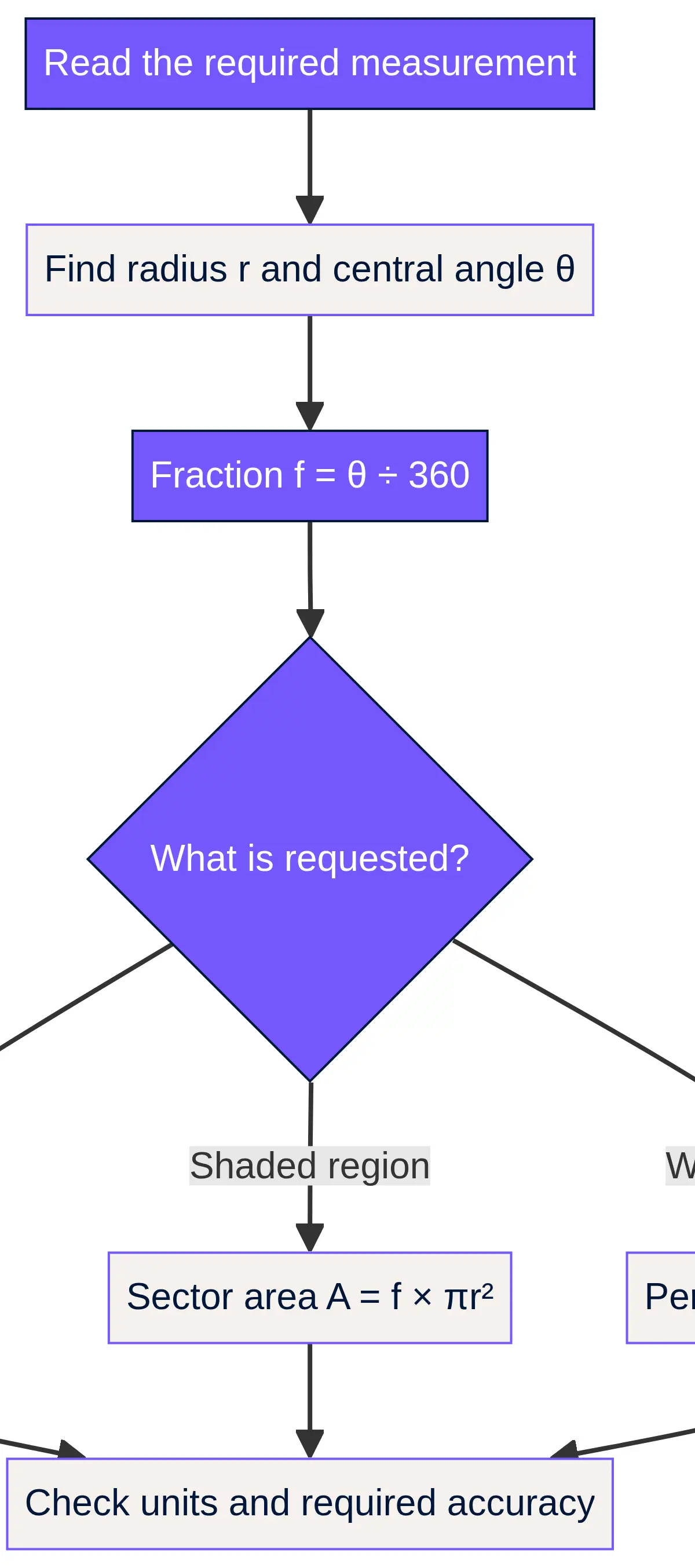
Here r is radius, d diameter, θ the angle in degrees, f the sector fraction, L arc length, A sector area and P perimeter. Radius and length units must match. The published 2026 Edexcel formula sheets supply whole-circle circumference and area, but do not print the sector formulas. Pearson has confirmed continuing formula-sheet provision for the lifetime of the current specifications; check the insert for your examination series. 3 4 5
Given on formula sheet, both tiers: C = 2πr = πd; whole-circle area = πr².
Must memorise or be able to derive, not printed: d = 2r and r = d/2; full turn = 360°; f = θ/360; L = f × 2πr; A = f × πr²; P = L + 2r; θ = 360L/(2πr); θ = 360A/(πr²).
Must memorise or derive, useful rearrangements: L = P − 2r; r = 360L/(2πθ); r = √(360A/(πθ)); A = rL/2 and L = 2A/r. These last two follow by cancelling the common fraction and π in A/L. They are valid for a sector of the same radius and angle, and are especially useful when area is given but perimeter is required.
Must derive, composite extensions: θ_major = 360° − θ_minor; A_ring = (θ/360)π(R² − r²); P_ring = (θ/360)2π(R + r) + 2(R − r).
Given on Higher formula sheet only: triangle area = (1/2)ab sin C. Setting a = b = r gives the triangle area inside a minor sector. Must derive: minor-segment area = sector area − triangle area. Radian formulas are A-Level material and are not needed for G18 degree-based questions.
Precision, Units and Graph Skills
Use the calculator's π key rather than replacing π with 3.14. Keep full precision in intermediate calculations and round once, at the end. Two decimal places counts digits after the decimal point; three significant figures counts from the first non-zero digit. Follow the stated accuracy, not a universal rounding rule.
Lengths convert by the linear scale factor: 1 cm = 10 mm and 1 m = 100 cm. Areas convert by its square: 1 cm² = 100 mm² and 1 m² = 10,000 cm². For example, a sector of radius 20 mm can be calculated entirely in millimetres, or with radius 2 cm entirely in centimetres. Do not mix those values within one calculation.
No graph is required to apply the sector formulas. If data or graphs are supplied, recognise that L against θ, at fixed r, is a straight line through the origin, with gradient 2πr/360 length units per degree. A against θ is also linear, with gradient πr²/360 area units per degree. A against r at fixed θ is quadratic, not linear. Read axis units and scales before interpreting a plotted value.
Exam Technique and Authentic Marking
Edexcel papers are 90 minutes long and each has 80 marks. The whole-paper average is 1.125 minutes per mark: a sensible practice target is about 3.4 minutes for 3 marks, 4.5 for 4 marks and 6.75 for 6 marks. This is a planning guide, not an official question-by-question time allowance. Paper 1 is non-calculator; Papers 2 and 3 permit a calculator. 1
A published example is June 2019 Paper 2H, question 12: the sector has radius 7 cm and area 40 cm², and candidates find its perimeter. Pearson's four-mark scheme allows P2 for finding the central angle or appropriate proportion, P1 dependent on that process for the arc length, and A1 for the perimeter. The scheme also describes partial credit for finding the whole-circle area. Its accepted perimeter includes 178/7 cm, approximately 25.4 cm. This is an official example, unlike the original teaching allocations elsewhere in this guide. 6
Write a formula, substitute the given values, simplify, then state the requested answer. For show that, derive the stated value independently. For explain, link a mathematical reason to the result. Examiners assess relevant mathematics, not decorative terminology or an unsupported answer copied from a target value.
Practical Applications and Active Revision
A sprinkler sweeping through 120° waters a sector, so water coverage depends on sector area. Edging a wedge-shaped flower bed requires perimeter, while edging only its curved front requires arc length. The question's wording determines whether straight sides count. A circular running-track bend requires an arc calculation, not a chord measurement.
There is no required practical for this GCSE Mathematics topic. An optional paper model can make the fraction visible: draw a circle, divide it into six equal sectors, and identify the one-sixth share of both boundary and region. The model illustrates the reasoning; it does not replace calculation in an examination.
Ten-minute tutor podcast
Listen once with your sketch, then attempt the quick-fire quiz without looking at the formulas. The episode includes thinking and writing pauses. Its chapters are introduction, core concepts, examiner tips, recall quiz and summary. Use the full transcript in podcast_script to revisit any explanation.
For stronger recall, attempt one arc, one area and one reverse-angle question today. Tomorrow, reproduce their methods without notes and mix in a perimeter question. A few days later, explain why the same fraction governs both arc and area. When you get a question wrong, record the decision that failed, such as using diameter or missing a boundary, then immediately solve a fresh version.
References
Visual Resources
3 diagrams and illustrations
Interactive Diagrams
2 interactive diagrams to visualise key concepts
Conceptual Flow Outline
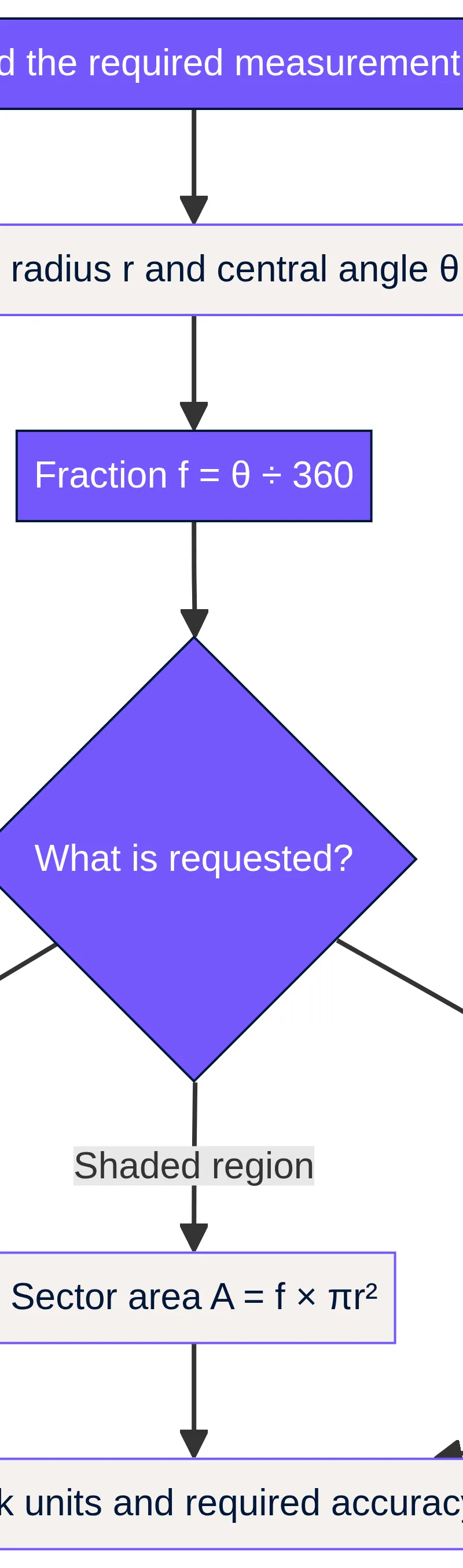
Choose circumference for an arc, circle area for a sector area, and add both radii for an ordinary sector perimeter.
Conceptual Flow Outline
Recover a central angle by dividing a given part by its matching whole, then multiplying by 360°.
Worked Examples
4 worked examples — open one to explore the question and available guidance.
Practice Questions
Try the question, then reveal an answer plan or example response
Original Edexcel-style question. A sector has radius 10 cm and angle 90°. Calculate its arc length in terms of π. [3 marks]
Hint: First identify what fraction of a full turn 90° represents.
Original Edexcel-style question. A sector is part of a circle with diameter 14 cm. Its angle is 60°. Calculate its area in terms of π. [3 marks]
Hint: The area formula needs radius, not diameter.
Original Edexcel-style question. A sector has radius 12 cm and arc length 10π cm. Work out its central angle. [3 marks]
Hint: Divide the arc by the whole circumference, then multiply by 360.
Original Edexcel-style question. A circle has radius 9 cm. Its minor sector angle is 80°. Calculate the perimeter of the corresponding major sector in terms of π. [4 marks]
Hint: The requested region uses the reflex central angle.
Original Edexcel-style question. A sector has central angle 120° and area 27π cm². Calculate its radius, then its perimeter in terms of π. [5 marks]
Hint: Rearrange the area formula to find r² before taking the positive square root.
Original Edexcel-style question, Higher-only sine-based extension. A minor segment is bounded by a chord and an arc in a circle of radius 6 cm. The angle subtended at the centre is 60°. Calculate the segment area to 2 decimal places. [6 marks]
Hint: Calculate the sector area, then subtract the isosceles triangle using (1/2)ab sin C.
Exam technique
How to turn what you know into marks
How to approach the question
Identify whether the target is arc, area, perimeter, angle or radius. Mark the relevant region and boundary. Convert diameter to radius and use consistent units. Find θ/360, choose the matching whole-circle formula, calculate and check. For a reverse question, find part/whole before converting to degrees. For major sectors or composite shapes, identify the correct angle and exposed edges first.
How to structure your answer
For a 3-mark teaching question, show formula or whole-circle measurement, the sector fraction applied or rearranged, and the final requested value. For 4–6 marks, label linked stages, such as radius, fraction, arc and perimeter. Actual Pearson schemes vary: M marks reward methods, P marks processes, A marks accuracy and C marks communication. A correct fraction is not automatically worth one mark. Original allocations here are indicative, not official.
Timing
90 minutes ÷ 80 marks = 1.125 minutes per mark across a complete Edexcel paper. Practice targets: about 3.4 minutes for 3 marks, 4.5 for 4 marks, 6.75 for 6 marks. These are flexible planning targets, not official per-question allowances.
Common pitfalls
- Using πr² for an arc or 2πr for an area: identify whether you are measuring a line or a region first.
- Dividing θ by 180: a complete turn is 360°, not 180°.
- Giving arc length for sector perimeter: trace both straight radii as well as the curve.
- Using diameter as radius: write r = d/2 before substitution.
- Selecting the minor angle for a major region: calculate 360° minus the minor angle.
- Mixing centimetres with millimetres: convert all lengths to one unit; square the conversion factor for areas.
- Rounding intermediate values or using 3.14: preserve π or calculator precision until the final answer.
- Treating an arc as a chord, or a sector as a segment: identify the curved and straight boundaries carefully.
What the command words want
- Compare
- Calculate like-for-like quantities and state how they relate, for example the sector with twice the radius has four times the area at the same angle.
- Explain
- Give a mathematical reason linked to the claim. For example: the perimeter includes 2r because both radii form part of the boundary.
- Describe
- Identify the relevant mathematical feature precisely, for example a sector has two radii and an arc. This is less common than numerical commands here.
- Evaluate
- In mathematics, evaluate usually means find the numerical value of an expression. It does not automatically require an essay considering both sides.
- Work out
- Use a clear calculation or sequence of calculations. Show enough working to make the method visible.
- Calculate
- Select the appropriate formula, substitute values, show arithmetic and give the requested measurement and accuracy.
- Show that
- Derive the stated result from the given information. Do not assume the target answer in the working; keep exact values where possible.
- State/Give
- Supply the requested value or fact directly, with units when applicable. If an exact form is specified, use it.
Watch or listen (optional)
Test your understanding of Geometry and measures - Mensuration and calculation: calculate arc lengths, angles and areas of sectors of circles
Active recall beats re-reading. Take an instant quiz now to test what you’ve learned and lock it into long-term memory.
7 days Premium · Then the free plan continues · No card, no charge